30.05.2026
- Noriaki Kakyoin: An Embodiment of Japan -
forewarnings:
- isnt really an analysis of kakyoin as a character, but more an analysis of his influence on people and my own interpretation of his effect
- i am NOT a japanese person so i dont know what its truly like to live in japan but as i used to learn japanese (when i was learning japanese i consumed a lot of japanese content ((not anime (((im not a weirdo i swear ((((please))))), i have some knowledge on the gist of japanese society.. it may be different now, it may have been different then, but take my information with a side of sodium.
Introduction
Hirohiko Araki is well-known for integrating social commentary into his works in very minute ways. This is observable more in his later works, but it still lies in JoJo’s Bizarre Adventure: Stardust Crusaders – a part that many people push aside when looking for significant messages in Araki’s work. It is understandable; Stardust Crusaders was meant to be the end of the JoJo's series, and being forced to release a new chapter every week meant a noticeable decline in quality, tacky shonen-flavoured villains and plot devices that jut out strangely. Even the creation of stands themselves were something created on the spot* (can’t find a source for this but honestly.. I believe it). Regardless of the conception of stands, Araki managed to write them in such a way that their existence could symbolise many things, intentionally or not (this sentiment will be quite relevant when discussing Araki). An amazing example of a character that portrays a relationship different to combat with their stand is Kakyoin Noriaki. In a way, Kakyoin laid the trackwork for more complex characters with conflict regarding their stands existence – see Okuyasu Nijimura, Fugo Pannacotta, Koichi Hirose – and gave fans a chance to see Kakyoin’s character in many different perspectives, with each person harbouring a different interpretation of his character. So in this analysis, we will not only examine what his role in the story represents in a greater sense, but also investigate just exactly why he is such an impactful personality to Japanese and Western fans alike with such little screentime.
Chapter One: Appearances
The first few panels of the story are already being put in place to create the substantial contrast between Jotaro and Kakyoin.
Without the portrayal of Jotaro as a ‘normal’, happy kid in the beginning, the reader wouldn’t understand the magnitude of his delinquency in the very next panels.


A social misfit being the main character is already a strong message Araki is pushing and further enhances just exactly what Kakyoin represents, or atleast, what I see him representing. We are constantly shown, whether it be through small interactions with Holly to him outright stating his moral code in the fight with Kakyoin, that despite Jotaro’s harsh appearance, he is a kind person. He goes out of his way to lock himself in jail to not harm anyone once acquiring his stand and even tries doing his own research on what his ‘evil spirit’ could be with the various occult and supernatural books seen in his jail cell.


Now, when we meet Kakyoin, he is shown as polite and inconspicuous, despite being under DIO’s influence. He could have fought Jotaro right then and there, couldn’t he? It’s not like he held back because there were bystanders around; he possessed a woman’s body and harmed people other than Jotaro during their fight. Kakyoin specifically goes out of his way to keep up niceties. Giving him a handkerchief that would only reveal its message when Jotaro’s guard was down, introducing himself, asking about his wellbeing…


This is why Jotaro and Kakyoin are great foils. Jotaro’s first appearance – a delinquent with a secret kind heart – suggests that Kakyoin is an honours student with a secret animosity for those around him. This is proved tenfold in the way Kakyoin attacks. Indirectly at first: the painting attack, the mannequin, the possession. There is a theme with him appearing here which I will label ‘Appearances’. Kakyoin wants to keep up a social appearance even while not being in the right state of mind. Almost like it’s ingrained into his being, the literal manifestation of his soul and fighting spirit cannot face his opponents in a fair way. Keep in mind that people with a flesh bud aren’t merely being possessed, the absolute WORST in them is being brought to the surface and amplified. Kakyoin’s principles have been something he has held for his whole life, be it heavily repressed because he knows it’s the wrong way to think. It’s only brought out because of an outside force; if not for DIO, he could have gone his whole life keeping up a pretty appearance with ugly morals. You may be thinking, “Hey, Kakyoin said he doesn’t bow down to other people so many times! It’s even on his official introduction page!” And to that I say, “Exactly”. He doesn’t. He just has a different way of showing it. The reason why I had started off this paragraph with explaining Jotaro as a character is to further amplify my point regarding Kakyoin. Jotaro actually holds many of the same personality attributes as Kakyoin, except he is unapologetic about it. He portrays Kakyoin’s own personality in a less socially acceptable way.

If Jotaro is the type of person that’s dense and unaware of his affect on other people, then Kakyoin is the type of person who is hyper-aware of himself around others, just like the character archetypes they both follow. In this panel where Kakyoin reveals to the reader his mindset, it’s the first time such a serene expression is drawn on his face during the fight.


A small light is illuminated near his face, usually meaning a moment of clarity a character is experiencing , and he speaks in a way that suggests he’s rehearsed that specific spiel many times before. It’s the only thing he’s really sure about, the only thing that's held stable for him, a feeling about the world he’s fallen back on countless of times. What could cause a person to have this view of the world? Being a stand user for your whole life? More on this later. Jotaro’s attempts to prove Kakyoin wrong ironically reveal that Kakyoin was right in a way – the loser of that battle was the ‘evil’ one. And even though Jotaro removed Kakyoin’s fleshbud, returning him to normal, it’s obvious through the way Kakyoin fights that he still partially believes that sentiment, and that it is true, but maybe the ends don’t justify the means. Only now, Jotaro has shown him that he doesn’t need to hide behind a disguise of fake sincerity, since if rowdy and unfeeling Jotaro Kujo could have so many people care for him, then so could Kakyoin, right? We can see Jotaro influencing Kakyoin almost immediately in the panels where they both tell each other their reasons for doing things. “Let’s just say you opened my eyes, that’s all.”

The reader, throughout the manga, will see Kakyoin slowly evolve from keeping to himself and not drawing attention, opting for ways to fight that disturb as little amounts of people as possible, to a person who lies to another Person about their best friend’s death, resorts to unnecessary violence towards a Person in an emotional situation and flings out random, hurtful insults to a Person, uncalled for (Person = Polnareff). Who does this unabashed indifference remind you of? Jotaro. The reader will see more and more of Kakyoin’s similarities to Jotaro unveiled, and only because Jotaro made Kakyoin feel secure enough to show it. Keep all of this in mind.. You may be thinking, “‘Not a character analysis’ my ass! What does this have to do with his cultural impact?!” Without this exposition, what I’m about to talk about next will not be as impactful. I have only scratched the first few chapters of Stardust Crusaders in an effort to familiarize you with some key concepts that will tie my point together. Throughout the next paragraph however, I will make some passing references to more scenes in later chapters which contain spoilers if you haven’t yet reached the end of the manga.
Chapter Two: Interacting with the World
Noriaki Kakyoin is a representation of the collective Japanese society. Not every single Japanese person ever, but the abstraction of the country, the spirit of it. First, take a look at his appearance: dressed in his gakuran even when he has the option to change clothes. His reason for this is that “a student has to dress the part”. Even when he is countries apart from his school, he cannot detach himself from the role of a ‘student’ in his society. His uniform has become his literal skin, and even when Kakyoin does something outlandish or atypical for a person, we are gently reminded through his vibrant green gakuran that he is but a mere schoolkid. I don’t think I need to explain why this is relevant when discussing the ties with Japanese society, as this concept extends to many other societies around the world. Being sectioned into a role suiting your age group until you eventually outgrow it and move to another. From student, to worker, to death. The difference is that Japanese society is aware of this and seeks to maintain it, pressuring young people who want to lead different lives to just grit their teeth and bear it. Kakyoin is self-aware enough to know that sunbathing fully clothed is unusual, but he cannot let go of that seed in his mind, that he is a student. Another thing about his appearance is that despite dressing in an extravagant way, he ‘isn’t noticed much’. With bright red hair in such a style, you would think the opposite, right? Especially since he was complimented for being beautiful when the group went to India. But this only happened once Kakyoin assimilated with the Joestars, when Kakyoin stopped purposefully making himself be unnoticeable. Despite any talents or gifts you may hold, it amounts to nothing in a society that prizes being as inconspicuous as possible. People grow up, not realizing they are amazing until they find people who let them be. Anyways, that was only taking apart his character design. Now let’s look at his overall character, linking each attribute to my point. He is an honours student that is tainted with poor mental health. He doesn’t tell his parents his issues and this causes them distress, despite having an overall good relationship with their son. His parents haven’t shunned him for having a stand, they simply don’t understand him, or rather, they just can’t, because Kakyoin won’t let anyone in. Kakyoin is naturally a smart kid, but it’s strange to be at the top of your class with such a mental state. His grades could be compensation for feeling like a burden to his parents for not being a cheerful and outgoing boy. It’s how he makes it up to them, because if he’s not going to have friends, at least he’ll have a future, right? Prioritizing education over social life is another common issue in Japanese society.. One that older generations push onto the youth. Kakyoin isn’t really being pressured by older people to act a specific way, though… He isolated himself, and planned to for his whole life, because he believed there was nobody in the world who could ever understand him. This is usually the route that turns someone into a hikikomori, another prevalent issue in Japan. Because his environment forced him to make himself invisible, he would have never found out that there were so many other stand users like him. Just like reality, people go about living their lives unaware that there are individuals who have the same issues, interests and hobbies as them, and they are closer than you’d think. It’s the fault of the society that creates this divide amongst people. Kakyoin’s transformation from being fleshbudded represents a Japanese person who is finally able to express themselves away from the expectations of their restrictive society. Even though he still holds his ‘the evil are the losers’ mindset, it’s directed to much better causes and his extreme loyalty switches to people with better morals. Kakyoin stops trying to pretend and can blatantly state his feelings on things, just like Jotaro. Kakyoin post-fleshbud is like a big ‘what-if’, like if people were able to be who they want to be after hiding for their whole lives. However… Jotaro is actually already an example of that concept. Because Kakyoin’s demise is the harsh reality for those types of people. He was extinguished immediately as he was gaining confidence in himself, as soon as he found a purpose to keep living. His murder was by, quite literally, ‘The World’. Araki’s message to the audience is that if you want to survive The World, you have to ‘Stand Proud’. You have to be fearless in who you are, and limn yourself with confidence like Jotaro. Otherwise.. Any doubt, and you may already find yourself gone. It’s how the three unabashedly themselves characters survived, and the others perished. Pretty grim, right..? I haven’t even talked about stand interpretations yet. When you think about how Jotaro’s Star Platinum is portrayed, it really enhances what Hierophant Green means to Kakyoin. Our first depiction of a stand being this strong and seemingly unbeatable vessel of power creates an expectation in the reader's mind that stands are meant to be respected. Each character makes it a point to comment on how strong, how resilient Jotaro’s stand is. Even Kakyoin himself commented on Star Platinum’s strength while fleshbudded. It’s not like Kakyoin thinks Hierophant Green is weak.. He actually overestimates his strength sometimes. But Kakyoin has grown up with this power and he doesn’t see much to be in awe of it. In fact, it’s caused all of his misery. So now we have two characters, same ability but different perspectives of it. Now let’s think about what stands could symbolise. Popular interpretations are mental illness, but not limited to others like secret interests/hobbies, quirks or disability, or even just an individual's true personality. It’s something that could be gained environmentally, genetically or even out of the blue. Now, thinking of stands from this perspective, we know that Jotaro is a person who has received one through genetics, and Kakyoin was born with one with no one in his immediate family being a stand user. Even though Jotaro was bound to awaken his powers, he had a support network which guided him down the right path and taught him that stands aren’t something to fear. He also immediately found out that there were others like him, further reinforcing how much guidance he got. Imagine what would have happened if Jotaro didn’t have Joseph or Avdol to help him.. He would have stayed in that jail cell, possibly for his whole life. Isolating himself from people, to protect them from himself. Doesn’t that sound familiar? Again, Kakyoin is a parallel of Jotaro. Some unfortunate people in this world don’t have opportunities to seek aid for issues they experience, and some people do. People like Kakyoin have to live life on ‘hard-mode’ because they don’t even realise help is a possibility.
The spin-off ‘Crazy Diamond Demonic Heartbreak’ isn’t really canon, but I like it because it actually portrays the aftermath of the events of Stardust Crusaders. Kakyoin’s cousin, Ryoko, was a person who looked up to him and didn’t realise how much he was struggling behind the scenes. She, like his parents, found it strange that he ‘ran away’ because of how well he hid his struggles. Another depiction of a troubled Japanese youth, their family only finds out how tough they were having it once they’re dead. His deep similarities with the problems in the society of Japan are also what makes him so relatable by many, which will now be explored in the next paragraph.
Chapter Three: Like an Emerald, Rare and Striking
The biggest factor of Kakyoin’s likeability as a character is how relatable he is. Each person I know who’s watched Jojo’s Bizarre Adventure has found Kakyoin to be memorable because of his backstory and motivations. Isolation is an inevitable part of the human experience and the way Kakyoin expresses his conflict is familiar to many people. Not only his backstory, but his general demeanour has viewers seeing themselves in him. In the wacky world of Jojo, Kakyoin and Avdol are both the ‘sane’ (and that’s pushing it) characters that viewers can empathise with as a sort of reader-insert, helping them be immersed more into the story. Kakyoin is one of the most popular Jojo characters in Japan, making it in the top 5 favourite Jojo characters at 4th place. His popularity from Western fans stems from memes rather than a genuine love for his character, which furthers my point that Kakyoin is a character that is meant to caricaturize Japanese society. Obviously, I’m not saying Western fans don’t also love him and relate to him, as fans have gotten better at not misinterpreting him over the years. But a character that is so heavily based on one's own country, customs and culture is bound to hit a person deeper than one that isn’t. Another aspect of his demeanour that fans cling to is his.. Well, to put it plainly, his coolness. His raw confidence he displays when he fights enemies is more captivating to viewers than simply spamming punches with no thought. The planning he deploys with Hierophant green, the stakes of his battles where you aren’t sure if he’s going to win or lose, and his flagrant thirst for justice against evil are sure to win over any person watching his scenes. And his coolness doesn’t stop at the anime. Even in Jojo's Bizarre Adventure fighting games, Kakyoin is somehow the most powerful fighter you could use. For example, in Heritage for the Future, using any variant of Kakyoin is banned in tournaments because he’s too good. People who don’t even know who he is unintentionally pick him simply because of his character design (which I could make a whole other essay for but maybe later). His seriousness is balanced by subtle humour; he isn’t outright goofy like Polnareff or Joseph, but creates his own type of comedy which he doesn’t even address himself, making it funnier (licking cherry, abusing Polnareff, being abused). He has created some of the most impactful memes in the fandom, and has indirectly influenced many other series. I can’t find it anymore, but I’m also pretty sure a picture of him was featured on the homepage of Niconico douga a long time ago. That’s akin to a Kakyoin being a feature on Youtube’s icon, or something. Anyways.. One thing I’ve been saving mentioning is that Kakyoin is so likeable because he is so moldable to interpret. People like characters that act like them, so with Kakyoin being such a relatable character, each person can generate their own Build-a-bear and strengthen their attachment with him. Especially since we don’t know, well, anything about his previous life. It’s an underrated opinion not meant to be in an essay really, but I think Kakyoin having such an underdeveloped backstory was good in the long-term. That sort of obscurity is important if you want fans to interact with a character. People have been able to create amazing stories that stem from theories about his family’s personality, his school-life, and his future jobs and relationships. If those aspects of him were revealed, people wouldn’t be able to project onto him that easily and his relatability factor would disappear. Whether Hirohiko Araki knew about the messages he was sending out with creating such a character, we will never know. But his inclusion in an anime like Jojo’s was crucial to show the reality of owning a stand, the reality of being different and the value of human connection.
Outroduction
Thinking about the time period in which Stardust Crusaders was being written (late 1980s) brings light as to how innovative a character like Kakyoin was during that era. And how an almost 50 year old character concept is still so relevant to this day, to modern Japanese society. I ended off the last paragraph instilling some uncertainty as to if Araki’s intentions for Kakyoin to be received in such a manner was purposeful or not. Honestly, Araki’s characters have a tendency to develop a conscience of their own. It’s not just speculation.. Kakyoin may have transformed himself from a narrative foil to a concept, an idea. I’ll end this essay with a fitting statement by Araki himself:
“It's difficult to explain (and I know it's sudden), but when I'm drawing I feel the existence of what I call gravity. In other words, while you might think that as an author I have utter control over the actions of the main characters via the progression of the story, or the world in which I make them live, it's not always like that. At some points, when the characters have no choice but to act against my will, I have had to draw scenes I never wanted to draw. I feel that this is "gravity", and that "gravity" is part of fate.”
*Upon further research, they were not created on the spot. The conception of stands however was just something that gradually cemented itself, so it was still something that didn’t have much meaning in the beginning.
Chinese Word Of The Day: 花 - huā
Meaning: (noun) flower
e.g 他的名字是花京院典明。
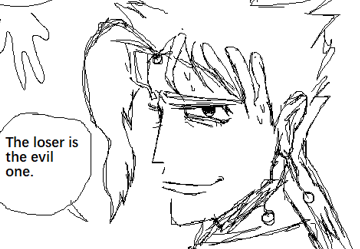
a simple redraw of a panel i liked..
i like to think that kakyoin's double cherry earrings in the earlier panels were a gift from dio, and that's why he later on only has one cherry on each earlobe.. is that too evil?
- Comment a Comment? -
